
Platform · Studio
Where your deployment gets built
Studio is the technical build surface of the platform. An AI forward-deployed engineer (AI FDE), a crew of agents, drafts your deployment. Your experts author and govern the operating model it runs on. One enforcement engine validates all of it, from the editor to production, and nothing ships unreviewed.
01The IDE
Real tooling for engineers and power users
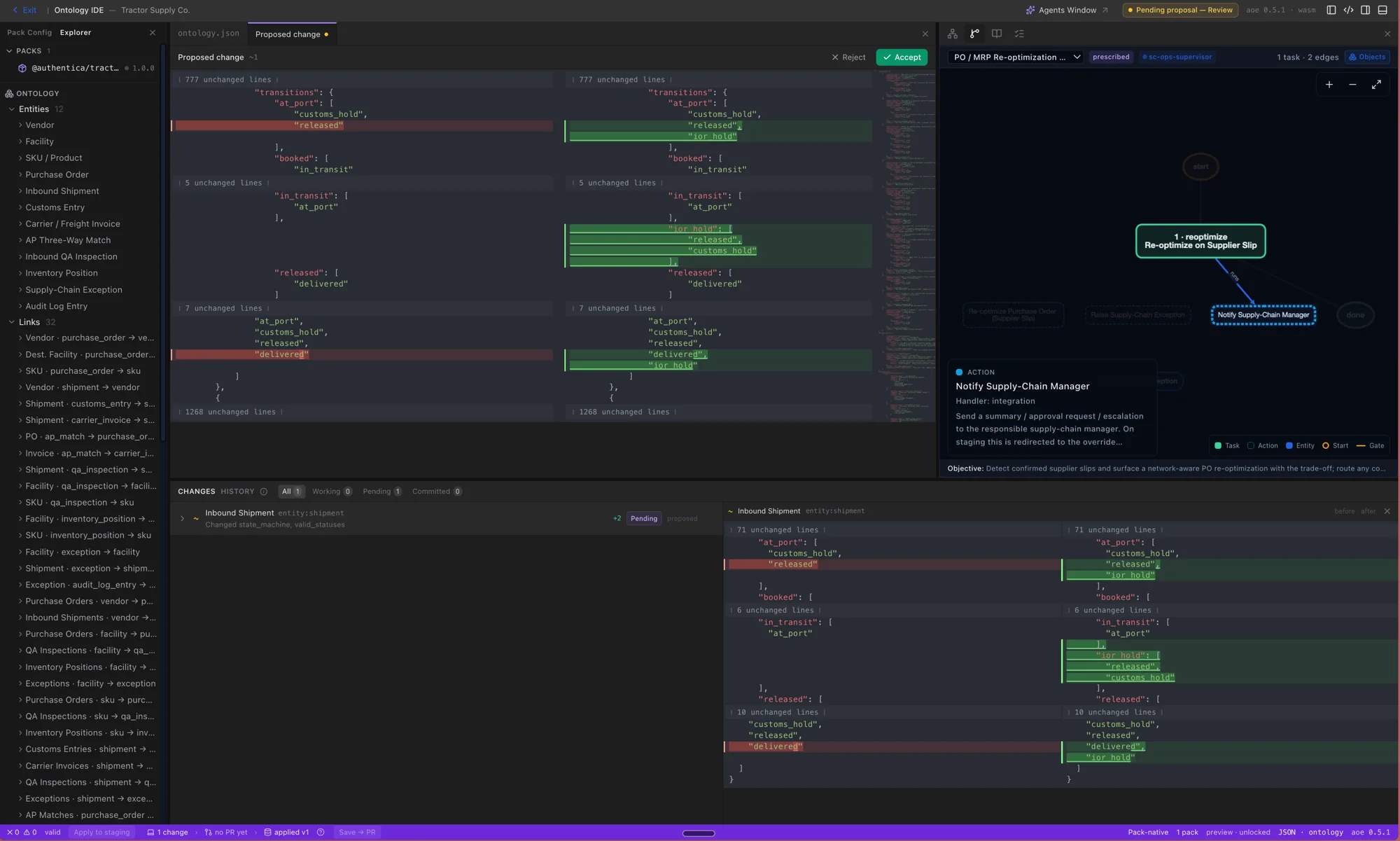
This is an IDE, not a no-code toy, and you don't have to be on our team to use it. Your engineers and power users edit the typed spec directly, entities, events, actions, and task types, with every change validated live and the diff right in front of them. What they edit is what the agents run on, so the person who understands the rule is the person who encodes it.
And it works the way your team already works: every change is a change set that moves through staging and lands as a pull request. Version control, review, and rollback, for your operating model.
02The build
Discovery to ship, stage by stage
The same four stages run on every engagement. Under each one: who does the work, and who signs it.
Stage 01 · Discovery
Read the operation.
Agents parse your SOPs, transcripts, spreadsheets, and system exports, and produce a grounded map of how your operation actually works.
agents do the workStage 02 · Operating model
Draft the model.
The map becomes a typed spec of your operating model: entities, events, actions, and task types, validated against structural rules before anyone reviews it.
agents draft · humans reviewStage 03 · Evals
Write the benchmark.
Real scenarios from your workflows become hand-labeled gold cases, graded by code: the benchmark your agents must pass before they touch production.
agents generate · humans labelStage 04 · Ship
Open the PR.
Every artifact lands as a pull request on the one gated write path, with a full audit trail. The agents write; people sign.
humans approve03The gates
Phases end on evidence, not dates
A deployment moves through three phases: Build, Evals, Live. The gates between them are exit criteria you can inspect, and you hold the sign-off.
Build
The AI FDE stands up your deployment: it drafts the operating model, scaffolds the benchmark, and opens the PRs. Every artifact is a draft for a person to review. You are not receiving autonomous output yet.
Evals
Your team runs the system against your real workflows, with daily check-ins. The agents shift from authoring to validating, and every miss you flag becomes a gold case before it can recur.
Live
Agents make real decisions in production. The AI FDE shifts to stewardship: drift watch, anomaly response, and a weekly cadence on operational health.
You hold the pen at every gate. The benchmark discipline behind them is OrgBench.
04One engine
One engine, from authoring to run time
The engine that enforces your model in production is compiled to WebAssembly and runs live in the editor. Every edit is validated and linted as you type, against the same rules that hold your agents at run time. What is valid in the editor is what runs in production. There is no "worked in the editor, failed on deploy."
01
Author.
Edit the typed spec and see the workflow an agent will follow, objective included.
02
Validate and lint.
The production engine flags problems as you type, not after you deploy.
03
Version and diff.
Every change is explicit and diffable down to the line.
04
Gate.
A person reviews. A breaking change is blocked before production.
05
Run time.
The same engine holds agents to the model, fail-closed.
05Change control
Nothing ships unreviewed
Editing the model changes nothing live. Every change travels the same road, whether a person wrote it or an agent drafted it.
01
Change set.
Edits gather into a reviewable set, so you can see what is working, pending, and committed.
02
Staging.
Apply the set to staging and try the change safely before it goes anywhere near production.
03
Pull request.
Save the session as a pull request. A person reviews it, and what reaches production is what was reviewed.
04
Rollback.
Versions are explicit, with snapshot rollback underneath. No edit is a one-way door.
06The IDE Agent
Describe the change. Review the diff.
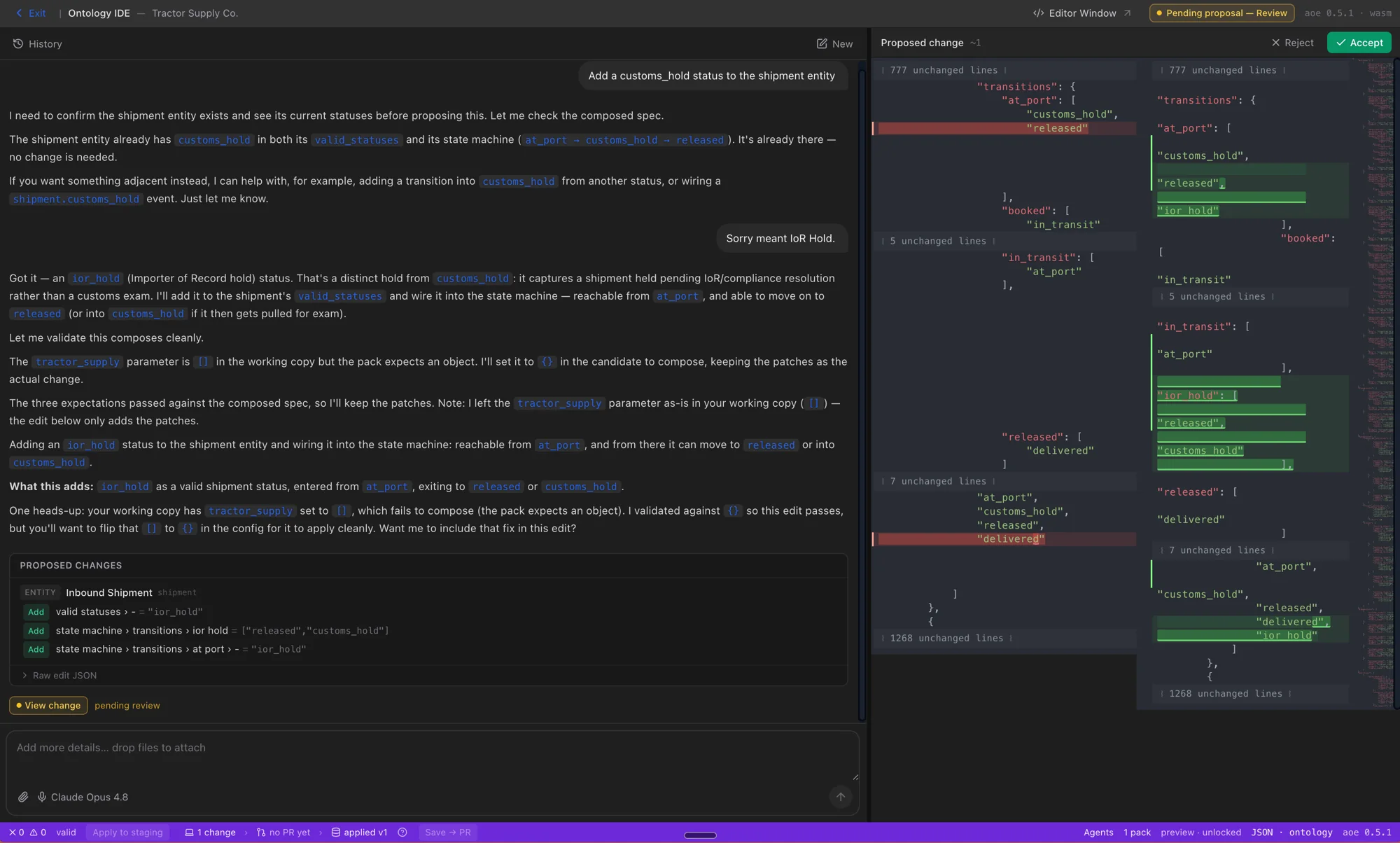
You can also just say what you want. The IDE Agent turns plain language into a drafted edit, the way a coding assistant drafts code: it proposes the change, explains its reasoning, shows which validation warnings it clears, and asks before applying anything.
Its proposals clear exactly the same validation, review, and gates a person's edits do. The AI that helps you author the model is governed by the same rules as the agents that run on it. Your experts hold the pen either way.
07FAQ
Common questions about Studio
Does AI actually build my deployment?
Agents do the drafting: discovery over your SOPs and data, operating model proposals, benchmark cases, and the pull requests themselves. A human forward deployed engineer owns the engagement, reviews everything that ships, and answers for the result. Nothing reaches your deployment without a person's sign-off.
What keeps agent-built work safe?
One gated write path. Every artifact lands as a pull request a person reviews and signs, and each phase ends on exit criteria you can inspect: the gold cases pass five runs out of five before the evals phase begins, and you give the explicit go-live sign-off before anything runs live.
Can non-engineers edit the operating model?
Yes. That is what the IDE is for. Your experts can edit the typed spec directly with live validation, or describe the change in plain language and review the IDE Agent's drafted edit. Either way the change passes the same review and gates before it ships.
What stops an edit from breaking production?
The engine that enforces the model in production validates every edit live in the editor, so what is valid in the editor is what runs. Changes apply to staging first, ship as a reviewed pull request, and sit on explicit versions with snapshot rollback.
Watch your deployment get built
Start with a workflow demo on sample data, then put the AI FDE to work on your first workflow. Every phase ends on evidence, and you sign every gate.